Zen Browser — A Calmer Way to Browse
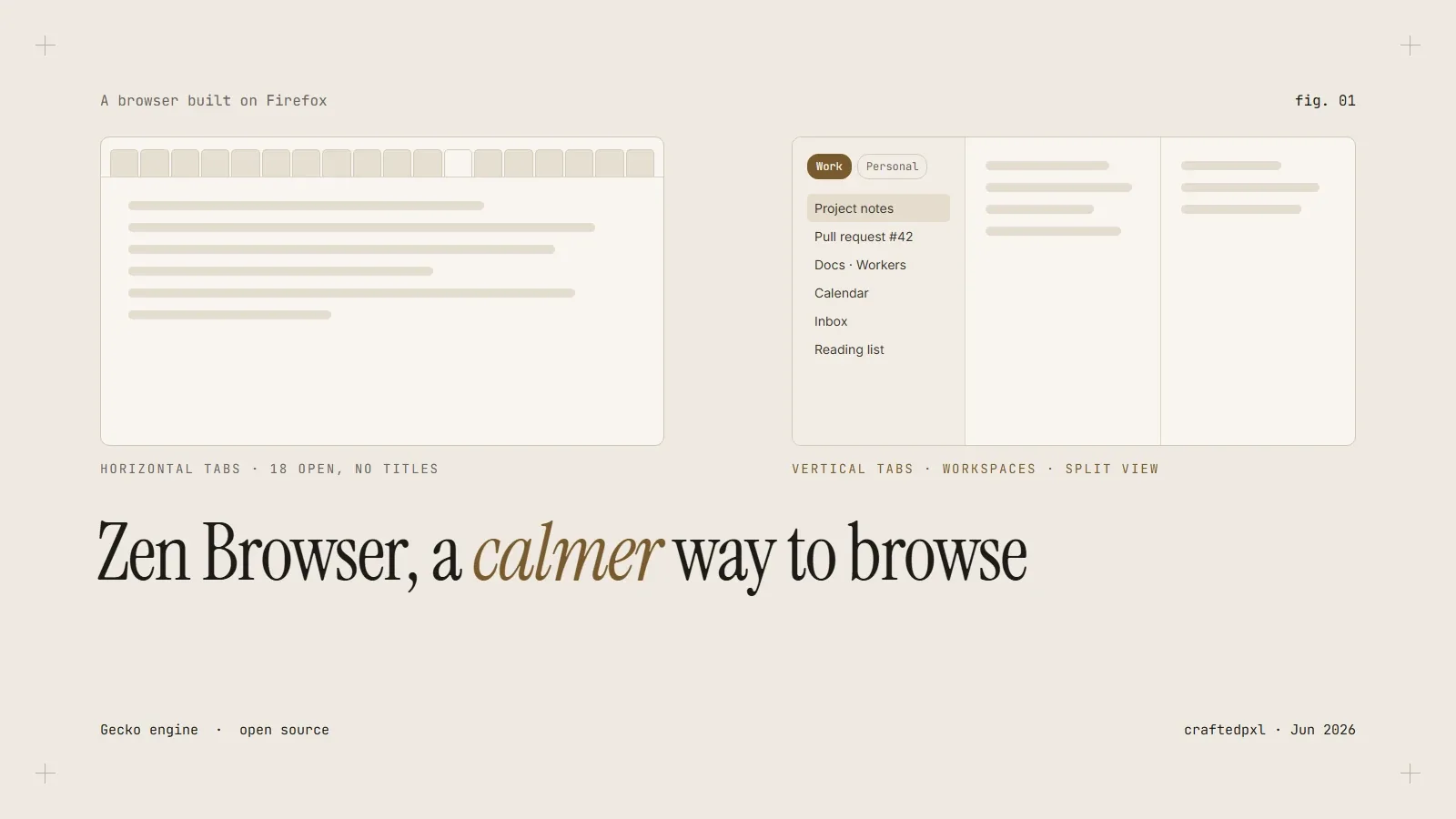
The browser is the one app most of us never close. It's where work happens, where we read, where we waste twenty minutes we meant to spend on something else. So it's strange how little most browsers care about your attention — they fill the screen with tabs you can't tell apart, nudge you toward an account, and quietly treat you as the product.
Zen Browser takes the opposite view. It's a free, open-source browser built on Mozilla's Firefox, and its whole personality fits in one line: a calmer way to browse, designed for focus rather than for selling your attention.
This is a first look at what it does well, and how it stacks up against the browsers you already know.
The idea in one sentence
Zen wraps Firefox's proven engine in a quieter, more deliberate interface — vertical tabs, workspaces, and split view — so one window can hold your whole day without feeling like clutter.
That's the pitch. Not a faster benchmark or a flashier logo, but a browser that gets out of your way.
Tabs that finally make sense
Most browsers stack tabs left to right until each one shrinks to a meaningless sliver. Zen moves them into a vertical sidebar, where titles stay readable no matter how many you open. On top of that sit Workspaces: separate sets of tabs for separate parts of your life. "Work" and "Personal" never bleed into each other, and switching between them swaps the whole sidebar in one click. Need two pages side by side? Split View tiles up to four tabs in a single window.

None of this is brand-new — Arc pioneered much of it — but Arc is winding down, closed-source, and Mac-first. Zen brings the same ideas to an open-source browser that runs everywhere.
Built on Firefox, not Chrome
Here's the part that matters more than it sounds. Zen runs on Gecko, the same engine that powers Firefox. Chrome and Edge both run on Chromium, Google's engine. So does almost everything else.
That means three of the four browsers most people use are, underneath, the same browser with different paint. When one company's engine sets the rules for the entire web, that's a quiet kind of power. Choosing a Gecko browser — Firefox or Zen — is one of the few ways an ordinary person keeps the web from becoming a single company's product.
Because Zen is Firefox underneath, it inherits Firefox's security patches, its strong privacy defaults, and its add-on library. You're not trusting a tiny team to reinvent a browser from scratch; you're trusting Mozilla's foundation with a better-designed roof.
How it compares

Against Chrome, the trade is simple. Chrome is fast, familiar, and everywhere — but it's built by an advertising company, ties tightly to your Google account, and treats your data as part of the business model. Zen asks for none of that and blocks trackers by default.
Against Edge, it's about restraint. Edge is a capable browser buried under things Microsoft wants you to use — Copilot prompts, Bing nudges, shopping pop-ups, a sidebar of features you never asked for. Edge can do vertical tabs, but you have to dig for the toggle. Zen ships calm by default.
Against Firefox, it's closer to family. Same engine, same privacy posture, same add-ons. Zen is what you get if you love Firefox's foundations but wish someone had spent a year on the interface — workspaces, split view, and a compact mode that hides everything until you need it. The cost is that Zen's small community can't match Mozilla's resources, and updates occasionally arrive a beat behind.
Honest about the trade-offs
A few things are worth knowing before you switch. Zen uses Firefox's add-on store, not Chrome's — most popular extensions exist in both, but a handful of Chrome-only ones won't carry over. It's young, released in 2024 and still shipping weekly, so you'll meet the occasional rough edge. And being community-built, it doesn't have a giant company behind it — which is either the whole appeal or a small risk, depending on how you look at it.
Who it's for
If you live with forty tabs open and lose track of all of them, Zen's vertical sidebar and workspaces will feel like someone finally tidied your desk. If you care that the web isn't run by one company, choosing a Firefox-based browser is a real vote. And if you just want a browser that opens, stays out of the way, and doesn't try to sell you anything, Zen is the calmest option of the four.
It won't be for everyone. Chrome diehards and people who need a specific Chrome-only extension have reasons to stay. But for anyone who's felt their browser working against them, Zen is worth an afternoon. It's free, it's open, and it's built on foundations you can trust — which is rarer than it should be.
About the Author
CraftedPxl is a digital playground exploring the intersection of design, code, and photography.